
Our Vision
Family
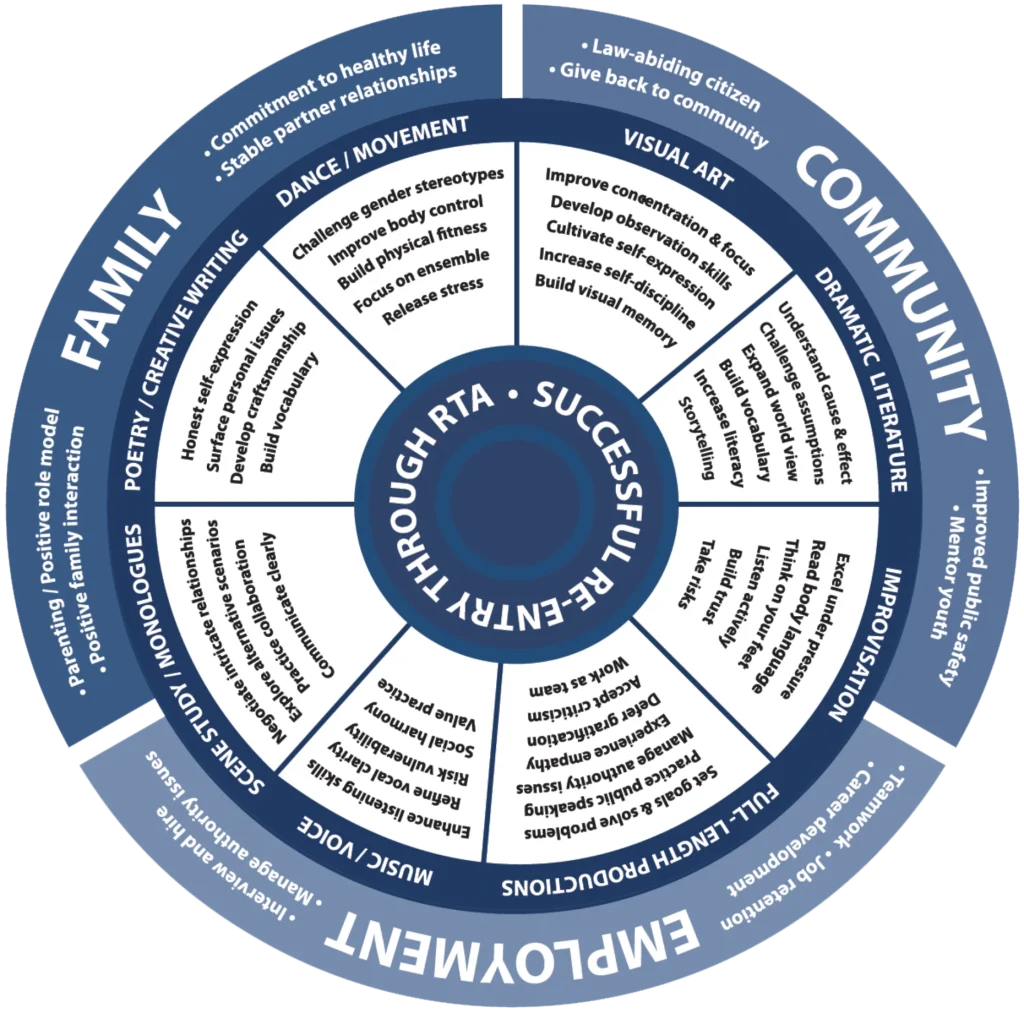
Commitment to a healthy life. Stable partner relationships. Positive role modeling. Strong family interaction. Parenting skills.
Community
Law-abiding citizenship. Giving back. Improved public safety. Mentoring youth.
Employment
Teamwork. Job retention. Career development. Interviewing and being hired. Managing authority.
Re-Entry
The emotional tools and peer community built inside carry forward into every part of life outside.
ABOUT RTA
The U.S. prison system is built on punishment — and it doesn’t work. More than half of people released return within three years, breaking apart families, destabilizing communities, and costing taxpayers billions.
RTA offers a better way. Launched at Sing Sing Correctional Facility in 1996, RTA is a national leader in arts-in-corrections programming, helping people in prison develop life skills through theater, dance, music, creative writing, and visual arts. Our approach models a justice system grounded in human dignity rather than punishment.
Our Reimagining Myself® reentry program prepares members for the social and emotional challenges of returning home. And the Oscar-nominated film SING SING, featuring RTA alumni, is based on our work.
The results are measurable. Less than 3% of RTA participants return to prison within three years. Many pursue higher education after joining the program. Facility staff report improvements in prison culture. And hundreds of alumni have gone on to become social workers, advocates, academics, and entrepreneurs in the communities they returned to.
HOW RTA WORKS
RTA is not a drop-in activity, and it’s not about becoming a professional artist. It’s a commitment to a community of peers that uses the arts as a tool for emotional, social, and cognitive growth.
A steering committee of incarcerated members leads the work at each facility, shaping curricula that range from a single master class in jazz guitar to a year-long project in script and character analysis. The art forms vary. The community is what ties them together.
The evidence backs this up – see our impact data for the research behind RTA’s approach.
Why the Arts
The arts don’t require an academic background. There’s no prerequisite, no correct answer, no judgment — anyone can participate. That accessibility matters: nearly one in three people entering state prisons nationwide do so without a high school diploma.
The arts are also experiential. They develop the ability to see the world from different perspectives, encourage positive risk-taking, and reveal hidden skills. They build the confidence and workplace-ready capabilities that follow — communication, goal-setting, problem-solving, and collaboration.
FREQUENTLY ASKED QUESTIONS
What life skills do participants build through RTA?
Through the arts, participants develop critical life skills like communication, collaboration, problem-solving, and resilience. These are practiced in real time through creative work and carry into daily life. They help individuals navigate relationships, pursue employment, and contribute meaningfully to their communities with confidence and purpose.
How does RTA strengthen family connections?
RTA helps participants rebuild relationships by strengthening communication, emotional awareness, and accountability. Through creative work, individuals learn to express themselves more openly and reconnect with loved ones in meaningful ways. These skills help rebuild trust, deepen understanding, and support stronger, healthier family relationships during incarceration and beyond.
Who can participate in RTA programs?
RTA programs are open to any individual where we operate , regardless of education level, disciplinary record, or conviction. We do not screen for prior experience or background. Participation is not limited to a select few. It is built on access and opportunity. All we ask for is a commitment and willingness to change.
How has the SING SING film highlighted RTA’s work?
SING SING brings RTA’s approach to life, showing how the arts help participants build agency, voice, and connection. The film has expanded national awareness, reached new audiences, and created opportunities for screenings and conversations that deepen public understanding. It reflects how participants grow and carry these skills into their lives beyond the program.
Who RTA Serves
RTA operates in 13 correctional facilities: 11 in New York State one in Delaware, and one in California, serving both men and women in medium and maximum-security prisons.
The population we serve reflects a national crisis. Nearly 2 million people are incarcerated in the United States today, and mass incarceration is rooted in institutionalized racism and systemic barriers to economic and educational opportunity.
In New York, people of color are disproportionately incarcerated: Black residents made up 15% of the state population in 2018 but 48% of the prison population. And while women remain a smaller share of the total, the female prison population has grown faster than the male population since 1980.
RTA operates in these facilities:
- Albion*, medium-security women
- Bedford Hills, maximum-security women
- Collins, medium-security men
- Fishkill, medium-security men
- Greene*, medium-security men
- Green Haven, maximum-security men
- Otisville*, medium-security men
- Sing Sing, maximum-security men
- Taconic*, medium-security women
- Wallkill*, medium-security men
- Woodbourne*, medium-security men
- Sierra Conservation Center*, a state prison in Jamestown, California
- Howard R. Young Correctional Institution*, a state prison in Delaware
*Facilities where Reimagining Myself® are or were conducted.