In 2022, states across the U.S. collectively spent a staggering $8 billion to reincarcerate individuals who had already been released.
This colossal economic burden underscores a sobering reality: our current system of mass incarceration is not only ineffective but also unsustainable. Each year, countless individuals reenter the criminal legal system, caught in a revolving door that punishes rather than rehabilitates.
The question arises: how can we break this costly cycle? The answer lies not in building more prisons, but in investing in rehabilitation.
At Rehabilitation Through the Arts (RTA), we have witnessed firsthand the transformative power of the arts in helping individuals break free from the patterns that lead to reincarceration.
_________
The Economic and Human Toll of Recidivism
Recidivism—when a person relapses into criminal behavior after serving time—has long been a challenge for the U.S. justice system. It comes at a high price, not only in terms of financial cost but also in its impact on individuals, families, and communities. Incarceration alone costs taxpayers billions of dollars annually, with the additional cost of reincarceration multiplying the strain on state budgets.
But the economic burden tells only part of the story. The human toll is just as significant. When individuals are released from prison without the tools, resources, or support to build a new life, they are far more likely to reoffend. This cycle perpetuates trauma, disrupts families, and creates a ripple effect across communities and among generations.
The Power of Rehabilitation
Rehabilitation, however, offers a way out. Programs like RTA provide the skills, confidence, and community connections that are essential for individuals to succeed after release. By using the arts—whether it’s theater, visual art, music, or writing—RTA helps incarcerated individuals develop a sense of self-worth, empathy, and accountability.
“This was something that brought us some kind of dignity, it brought us our humanity.” – Manuel Olivera, RTA alumnus who co- wrote a play for an ensemble of actors while incarcerated in upstate New York. Through the power of creative expression and prose, Manuel reclaimed his voice, his dignity and his humanity in a place that was created to punish him.
Art opens the door to self-expression, reflection, and healing. For many who participate in RTA programs, it is the first time they are encouraged to explore their potential, imagine a different future, and believe that change is possible. By providing a safe space to grow, our programs enable participants to take ownership of their lives and chart a new path.
Breaking the Cycle
Rehabilitation works, and the evidence is clear. Our innovative programs unlock potential, rebuild lives, and inspire positive contributions to communities. The results speak for themselves—less than 3% of RTA participants return to prison.
Studies consistently show that individuals who engage in educational, vocational, and therapeutic programs while incarcerated are less likely to reoffend. RTA take this a step further by fostering deep, personal transformation through the arts, which leads to lasting behavioral change.
“My daughter was born at the same time I was rehearsing my first play for RTA, a production of Cyrano de Bergerac. The experience of preparing for a part, rehearsing with members and performing in front of an audience allowed me to understand what responsibility was, what accountability was, what patience was.” – José, RTA alumnus
The impact of rehabilitation extends beyond the individual. When a person who was once incarcerated reintegrates into society as a contributing member, it strengthens families, creates safer communities, and reduces the economic burden of reincarceration. The ripple effect of rehabilitation is profound, touching not only the individual but also the entire network of people in their life.
The Path Forward
As we continue to confront the massive cost of incarceration, we must ask ourselves where our priorities lie. Is it more sustainable to continue pouring billions of dollars into reincarcerating people, or should we invest in programs that offer a real chance at breaking the cycle of incarceration?
At RTA, we believe in the latter. Our work is proof that rehabilitation is not just possible—it’s essential. By offering individuals the opportunity to transform through the arts, we are investing in a future where people can reclaim their lives and make meaningful contributions to society.
“I made a mistake, and it’s a chance for me to do better. RTA was life-changing for me. It helped me create a new mindset, change my perspective and let me express myself.” – Dunasha, RTA Alum whose participation in RTA’s creative arts workshops and theater productions helped her grow into the person she wanted to be during her time at Bedford Hills Correctional Facility.
The value of rehabilitation far outweighs the cost of incarceration. It’s time to rethink how we approach justice and put rehabilitation at the center of the conversation. By supporting programs like RTA, we can create a justice system that prioritizes healing, growth, and second chances.
Together, we can break the cycle and build a future where incarceration is no longer a revolving door, but a place for true transformation.
_________
Let’s shift the conversation from punishment to possibility. Support RTA today and join us in making a lasting impact on the lives of those we serve, as well as on their families and communities.
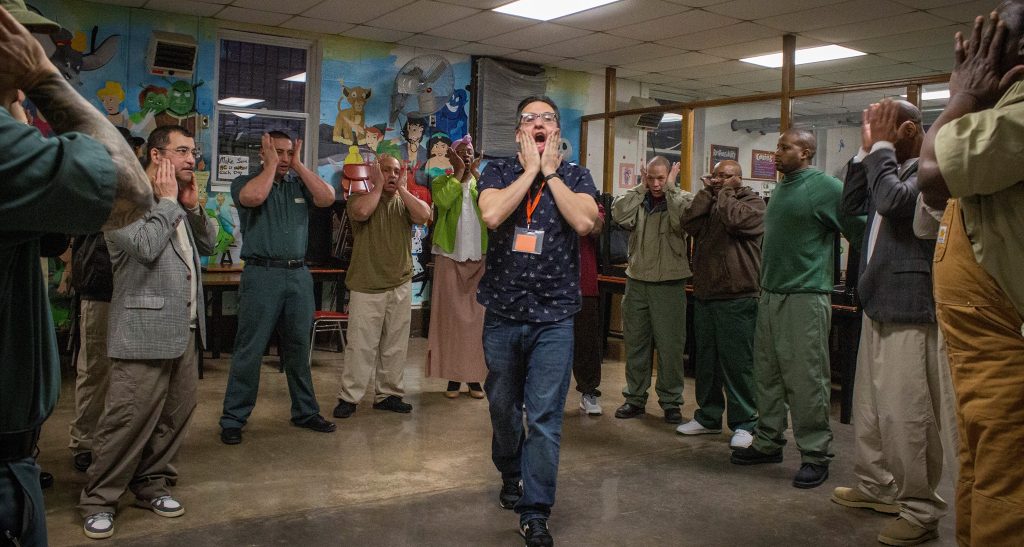
Feature Image: Nick Lopez, RTA Teaching Artist warms the group up before “Dutch Crown” at Woodbourne Correctional Facility. Directed by Shawn Fischer and written by RTA alumnus Philip C. Hall, this was RTA’s first performance at Woodbourne attended by families of RTA participants.